Travel to the Andromeda Galaxy
In Physics today, Bickers lectured on Einstein’s Theory of Relativity. He ended class with this thought. Suppose you wanted to visit the Andromeda galaxy, and let’s say it’s 20 million light years away. You would say, no way, it’s impossible. Anything that has mass must always move at a speed less than that of the speed of light. That’s true, but the distance of 20 million light years is from the perspective of Earth.
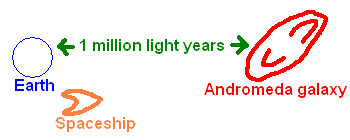
(not drawn to scale)
When you travel at a speed near that of the speed of light, the distance gets shorter. And it can get infinitely short if you get infinitely closer to the speed of light (c). This is based on the Lorentz factor, which is equal to 1/sqrt( 1 – v^2 / c^2 ).
So let’s say you go so fast that the distance becomes just one light year. That means a round trip will take 2 light years. This way, you actually could visit the galaxy. It would take you just 2 years for a round trip.
However, for your friends back on Earth, 2 million years would have passed, so there’s no way you would be able to tell them about it and all the amazing things you found in the Andromeda galaxy.
Two students sitting next to me said that for the person on the spaceship, his clock would show only 2 years, but his body would age 2 million years. What the heck?! People are not very smart. I talked with them about it, and I could not manage to convince them that your body would age at the same rate as the clock that’s traveling with you. Apparently, Bickers said something earlier in the lecture that they interpreted as stating that everyone’s body always ages at an absolute (and equal) rate. Hogwash (nonsense)! It’s times like these that I feel smart. Of course, it won’t be long until something happens that makes me humble again.
This a Tema!!!
What are you talking about?
Firstly a light year is a measure of distance..
Secondly there is no way you would be able to travel to andromeda and back within two years. 2 million light years would mean it would take you 2 million years to get there even travelling at the speed of light..
Do some research!!
His point is time slows down from the perspective of the traveller, so while 2 million years passed for the rest of the universe, only two years would pass for him — sort of a form of stasis by travelling very fast. And, although it’s not important for the sake of the argument, if the physics teacher did an ounce of research he would find Andromeda is 2 1/2 million light years away. Also, it would take about 1 year to accelerate to the speed of light and another year to decelerate if you didn’t want to squash him with g-forces… but the time in between could seem almost instantaneous if he was travelling very very close to the speed of light.
I was wrong.. trying to apply Newtonian mechanics to a relativistic problem… it would actually take about 28 years at 1 g acceleration to reach Andromeda, from the traveller’s perspective (still 2 1/2 million years from everyone else’s)… and I’m not sure how deceleration would work in that context.
Well… I learned from my physics teacher last week that if you traveled close to the speed of light that you would likely have a hard time concentrating for you wouldn’t be able to focus your eyes cause things would be flying by awfully fast. And if you had to make any calculation changes in your space ship’s direction you might make a few errors. Besides imagine once you arrived at the Andromeda Galaxy it will likely be hard to determine where to land if you’re not feeling focused and alert. Probably you would have not slept real well either. So that would effect your intestinal and elimination rythyms. Pretty tough trip when you think about it. Not too many astronauts will be jumping to make that trip very often.
I would like to point out that ‘light Year’ is a unit of distance not a unit of time. Also this is just a theory not proven and we don’t know the effect of the space outsifde our solar system on the time taken. We are assuming we can travel in a straight line, this, however, is unlikely as the effect of the super massive black hole will pull us off course before we even leave our own galaxy. We are in relative protection in our solar system and we have no way of knowing what will happen when we leave our galaxy.
I have read a theory that if we travel 99.999999% of the speed of light it will take fifty years to reach Andromeda. This will only be in comparison to the team aboard the ship. By the time they have made the 100 year round trip, for them, providing they don’t stop, 2500 years will have passed on Earth.
No way… Mr. Harry, light year is the distance travelled by light in one year. so it means that if you travel exactly 100% at the speed of light, it would take 2.5 milliion years to reach Andromeda galaxy, since it is 2.5 million light years away from our earth.
Calculation 1 – even if you travel ” exactly one Million ” times faster than “SPEED OF LIGHT”, it will still be a long travel . that is , 2.5 years will take to reach Andromeda galaxy.
Calculation 2- using our latest technology spaceship, that is 70km/sec, it would take mind boggling of ” 10,71,42,85,715 ” yeast to reach Andromeda galaxy… (that is approx. 10 billion years will take…)
Given the right speed (which is actually slower than the speed of light) it would indeed take 50 years to reach the Andromeda galaxy, whilst millions of years passed for those on Earth. This is a consequence of special relativity, about which I’m reading now and as such have not got my head around completely yet :P That’s actually the reason I’m on this post!
But yeah those who are claiming it would take 50 years to reach the Andromeda given the right speed, might seem like they lack basic knowledge of physics, but in fact are applying the implications of pretty advanced physics! To find out more have a read about Lorentz contraction and time dilation.
Giri, look up the relativistic effects of time dilation and length contraction that Harry is referencing. He is not wrong. From our view on Earth, it takes light 2.5 million years for light to me between the two galaxies. From the perspective of the light particle, it gets there instantly. Light does not experience elapsed time nor distance between objects. Anything with mass can’t move the speed of light (I.e. us), but we cut get ever closer to it, and the closer we get, the more our experience of time resembles light’s. You could get to Andromeda within a few years of your personally experienced time, depending on how fast you were going.
We have measured these relativistic effects directly. All of our satellites have to have a correction built into them to adjust for the very small changes in time they experience compared to us on Earth, and we see these effects in the decay of heavy particles in particle accelerators. We observe particles moving near the speed of light taking much longer to decay.